If you've been shopping for computer memory in Pakistan recently, you've probably noticed something frustrating: RAM prices are climbing fast, and the deals that once existed seem to be disappearing.
Whether you're looking at DDR4 or the newer DDR5 modules, the numbers on the price tags are moving in the wrong direction.
Here's what Pakistani consumers are facing:
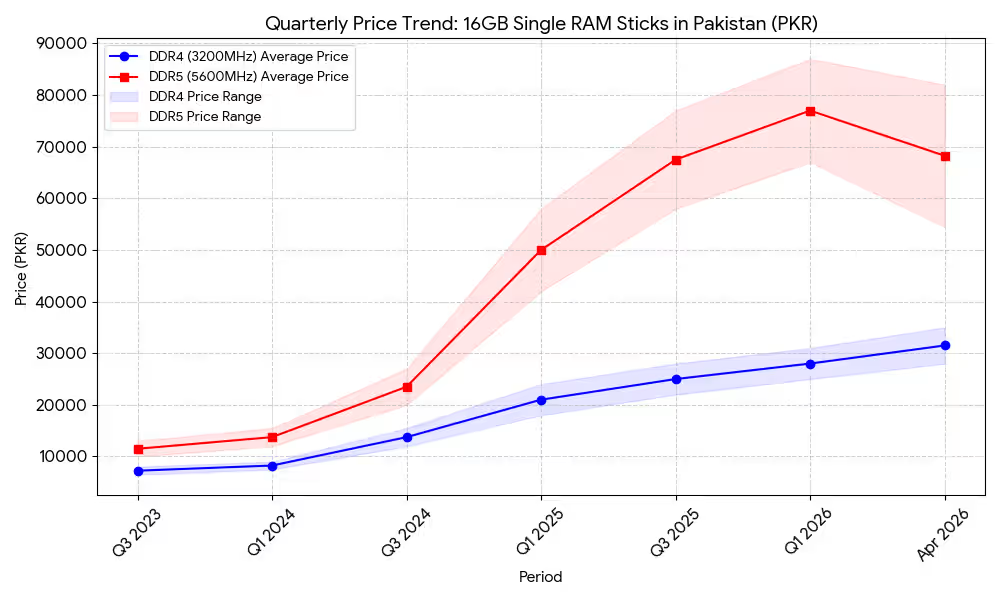
- A 16GB DDR4 stick that cost around PKR 12,000-15,500 in Q3 2024 now commands PKR 27,999-34,999
- 16GB DDR5 sticks that were PKR 20,000-27,000 in Q3 2024 have climbed to PKR 54,499-82,000
This isn't just a Pakistan problem—it's a global phenomenon—but the impact on Pakistani consumers is particularly significant given the currency fluctuations and import challenges the country faces.
Understanding why RAM prices are increasing requires looking beyond simple supply and demand. The memory market is experiencing a perfect storm of factors:
- Unprecedented demand from AI data centers
- Supply chain constraints
- Manufacturing consolidation
- Geopolitical pressures
For Pakistani gamers, PC builders, and anyone looking to upgrade their systems, knowing these reasons can help you make smarter purchasing decisions and perhaps time your buys better.
In this comprehensive guide, we'll break down every factor driving the RAM price surge, look at specific DDR4 and DDR5 trends, and provide practical advice for navigating this challenging market.
The Global Memory Shortage: Understanding the Big Picture
The RAM price increase you're seeing in Pakistan isn't happening in isolation. We're experiencing a global memory shortage that analysts are calling one of the most significant in the industry's history.
According to research from IDC and Gartner, memory costs have surged dramatically, with some categories seeing price increases of 11-16% in the first quarter of 2026 compared to late 2025.
This isn't a temporary glitch or a seasonal fluctuation—it's a fundamental restructuring of how memory resources are allocated globally, and it has direct implications for what you pay at your local computer shop.
Impact on Manufacturing and Shipments
The shortage is so severe that major research firms are now revising their forecasts for PC and smartphone shipments downward.
Key projections:
- Gartner projects worldwide PC shipments will decline by 10.4% in 2026
- Smartphone shipments dropping by 8.4%
- Reasons: manufacturers can't get enough memory components at reasonable prices to meet their production targets
When data centers, cloud providers, and AI companies are willing to pay premium rates for memory chips, the entire supply chain gets pulled in their direction, leaving consumer markets like Pakistan facing tighter supplies and higher prices.
Why This Shortage Is Different
What makes this shortage different from previous ones is its duration and depth.
Past memory price spikes were typically triggered by:
- Natural disasters
- Factory fires
- Temporary demand surges that corrected within months
This current situation stems from structural changes in how the world uses computing power. AI applications, machine learning workloads, and large language models require enormous amounts of high-speed memory to function, and tech giants are locking up memory supplies years in advance through long-term contracts.
The result: consumer RAM availability remains constrained while prices continue their upward trajectory.
AI Demand: The Primary Driver of RAM Price Increases
When you ask why RAM prices are increasing, the most significant answer in 2025 and 2026 is AI demand.
The artificial intelligence boom has fundamentally altered the memory market landscape in ways that directly impact what you pay for RAM in Pakistan. Data centers powering AI services from major tech companies need vast quantities of DRAM—the same type of memory used in your desktop computer or gaming rig.
This competition for the same underlying memory chips means that consumer RAM supplies are being cannibalized by enterprise demand, driving prices up across the board.
The Numbers Behind the Surge
The numbers are staggering when you look at what's happening at the component level:
- DRAM contract prices are forecast to jump roughly 11-16% in Q1 2026 alone
- Some categories experiencing around 13-16% increases over previous quarters
- DDR5 chips have seen spot prices rise roughly 173-204% since Q3 2024
Industry analysts expect server memory prices to potentially double by the end of 2026 compared to early 2025 levels, and these increases inevitably filter down to consumer markets.
The Ripple Effect on SSDs
The ripple effects extend beyond just RAM itself. The same AI-driven demand that drives up DRAM prices also affects NAND flash memory used in SSDs, creating a situation where both your RAM and storage costs are rising simultaneously.
Major NAND manufacturers are shifting production capacity toward higher-margin enterprise products, leaving consumer SSD supplies tighter and more expensive. This is why you're seeing articles about SSD and RAM price increases happening at the same time—they share the same root cause in AI infrastructure buildout.
What This Means for Pakistani Consumers
For Pakistani consumers, this means that waiting for prices to return to 2023-2024 levels isn't realistic in the short term.
The AI boom shows no signs of slowing, and as more companies race to build AI capabilities, memory demand will remain elevated. Understanding this helps set realistic expectations and focuses attention on strategies for getting value from your purchases rather than chasing phantom deals.
DDR4 vs DDR5: Comparing Price Trends and Value
If you're deciding between DDR4 and DDR5 RAM for your next build or upgrade, the price comparison is crucial—and it's more complicated than simply choosing the cheaper option.
DDR4 RAM has been the standard for several years, and its mature manufacturing base initially kept prices reasonable. However, the current market dynamics are affecting DDR4 in unexpected ways, creating situations where older technology is actually becoming more expensive relative to its performance benefits.
Price Comparison Over Time
Let's look at the numbers that illustrate this trend:
| Period | 16GB DDR4-3200 Cost | 16GB DDR5 Cost |
|---|
| Summer 2025 | PKR 22,000-28,000 | Higher baseline |
| Early 2026 | PKR 25,000-31,000 | Rising proportionally |
In summer 2025, a decent 16GB DDR4-3200 module typically cost between 22,000 and 28,000, making it an excellent value proposition for budget-conscious builders. By early 2026, that same module was commanding 25,000-31,000 due to supply constraints and cross-market pressures.
Meanwhile, DDR5 prices, while also rising, have seen more dramatic percentage increases in raw dollar terms, creating an interesting valuation shift in the memory market.
Why DDR4 Is Getting More Expensive
The reason DDR4 is becoming more expensive despite being the older technology relates to market dynamics. As major manufacturers shift production capacity toward DDR5 to meet enterprise and AI server demand, DDR4 production lines receive less investment and maintenance.
Fewer new DDR4 modules enter the market, while demand from budget-conscious consumers and businesses needing affordable systems remains steady. This supply-demand imbalance pushes DDR4 prices upward even without direct AI competition, since the manufacturing ecosystem itself is contracting around the technology.
Strategic Dilemma for Pakistani Buyers
For Pakistani buyers, this creates a strategic dilemma:
- If you're building a new system, DDR5 motherboards and processors represent the future, but the total system cost is higher
- If you're upgrading an existing DDR4 system, you might find that buying more DDR4 RAM now costs almost as much as making the leap to a new platform entirely
The choice depends on your specific situation, budget constraints, and how long you plan to keep the system. For gaming-focused builds, DDR4 still offers excellent performance at more accessible price points, but the gap is narrowing faster than many expected.
Supply Chain Factors Contributing to Price Increases
Beyond AI demand, several supply chain factors are amplifying the RAM price increase in Pakistan and globally.
The memory chip manufacturing industry is heavily concentrated, with just a few major players controlling most of the world's DRAM production. Samsung, SK Hynix, and Micron together account for the vast majority of DRAM supply, and when these companies face production challenges or make strategic decisions about capacity allocation, the effects ripple through the entire market.
Manufacturing Process Transitions
One significant factor is the transition from older manufacturing processes to newer ones. As memory manufacturers move to more advanced process nodes (like 10nm-class and below), they must phase out older equipment and retool factories.
This transition period:
- Temporarily reduces overall production capacity
- Requires massive capital investment
- Costs get passed on to consumers through higher prices
- Timeline for returning to "normal" production levels extends months or even years into the future
Geopolitical and Import Factors
Geopolitical factors also play a role in the supply equation. Trade restrictions, tariffs, and regional political tensions can disrupt the flow of memory components from manufacturing hubs in South Korea, Taiwan, and China to end markets like Pakistan.
Import duties, customs procedures, and currency fluctuations add layers of cost that compound the base price increases from manufacturers. For Pakistani consumers, the PKR's valuation against the US dollar means that even modest increases in dollar-denominated RAM prices translate to significant jumps in local currency costs.
The Local Supply Chain Markup
The logistics of getting RAM modules from factories to your local computer shop involve multiple intermediaries, each adding their margin. When global memory prices are rising, these intermediaries often accelerate their ordering to secure inventory, further tightening available supplies.
The result is that Pakistani consumers sometimes see price increases even before local stock runs low, as dealers preemptively adjust prices to reflect expected future costs.
This forward-looking pricing behavior is common in markets with currency volatility, where uncertainty drives protective pricing strategies.
How Much Have RAM Prices Actually Increased?
When we talk about RAM price increases, concrete numbers help illustrate the scale of the problem.
In Pakistan specifically, tracking DDR4 pricing across quarters shows a clear upward trajectory:
| Period | 16GB DDR4 (3200MHz) Price |
|---|
| Q3 2024 | PKR 12,000-15,500 |
| Q1 2025 | PKR 18,000-24,000 |
| April 2026 | PKR 27,999-34,999 |
This represents a 50-55% increase in just two quarters, which significantly impacts budget planning for anyone building or upgrading a PC.
Percentage Increases by Category
The percentage increases vary by specification and manufacturer, but the overall trend is unmistakable:
- Budget DDR4 modules: 126-133% increase since Q3 2024
- High-performance DDR4 kits and DDR5 modules: Even steeper climbs
- DDR5 pricing: 173-204% increases in some categories
- Some premium 16GB sticks: Now costing roughly 2.7 to 3.0 times what they did in Q3 2024
These aren't incremental adjustments—they represent a fundamental restructuring of what consumers should expect to pay for computer memory.
Global Context
Looking at the global market provides context for these Pakistan-specific figures. Industry reports indicate that DDR5 chip prices have "exploded" over recent months, with triple and sometimes quadruple increases in certain segments.
Memory prices across the industry have surged 11-16% from Q3 2025 into Q1 2026, with DRAM, NAND, and HBM (High Bandwidth Memory used in AI accelerators) all hitting record-breaking highs.
The chart data shows that we've entered genuinely unprecedented territory for RAM pricing, making past price fluctuations look modest by comparison.
Implications for Pakistani Gamers
For gamers and PC enthusiasts in Pakistan, understanding these numbers helps frame expectations. The era of abundant, cheap RAM that characterized 2019-2023 appears to be over, at least for the foreseeable future.
Budgeting recommendations:
- Account for memory costs that are significantly higher than historical averages
- While waiting for prices to eventually stabilize or decline makes sense for non-urgent purchases
- Those who need RAM for current projects or system reliability may want to buy sooner rather than later if further increases seem likely
DDR3, DDR4, and DDR5: Price Dynamics Across Generations
The RAM market now spans three generations of technology, and each has its own pricing dynamics that affect Pakistani consumers differently.
DDR3: Legacy Technology Becoming Scarce
DDR3, the oldest still-relevant technology, has become increasingly scarce as manufacturers phase out production. While DDR3 remains relevant for older systems and certain embedded applications, the price increases for this generation reflect scarcity more than demand.
If you're trying to upgrade an older system that uses DDR3, you may find limited availability and prices that seem high for what is now legacy technology.
DDR4: The Workhorse Under Pressure
DDR4 occupies an interesting middle ground. It's the workhorse of current gaming and productivity systems, offering excellent performance at reasonable prices relative to DDR5.
However, DDR4 is also the technology most affected by manufacturing capacity shifts. As factories retool for DDR5 production, fewer DDR4 modules roll off assembly lines, creating upward price pressure even from reduced supply.
For Pakistani consumers with DDR4-based systems, this is bittersweet news—it validates the platform choice made years ago but makes expansion more expensive.
DDR5: The Cutting Edge at a Premium
DDR5 represents the cutting edge of consumer memory technology, and its pricing reflects both newer manufacturing processes and intense competition from AI data centers for the same chips.
While DDR5 prices have risen substantially, they started from a higher baseline than DDR4, so the absolute price increases in Pakistani Rupees are substantial but somewhat proportional to initial costs. The DDR5 price increase percentage has been significant, but these modules also offer higher performance ceilings, which matters for future-proofing considerations.
Making the Right Choice
The practical implications for Pakistani buyers depend heavily on their current situation:
- Someone with a DDR4 system should seriously consider whether a DDR5 upgrade makes financial sense—or whether maximizing their existing DDR4 setup with additional modules or other component upgrades provides better value
- Someone building new has a clearer path—DDR5 is the future-facing choice, even if it costs more upfront
The key is matching your memory purchase to your actual performance needs and system constraints rather than simply buying whatever is cheapest or most expensive.
Is RAM Price Increase Temporary or Here to Stay?
A natural question when facing rising prices is whether the situation is temporary and will correct itself, or whether we're facing a new normal.
Based on current industry analysis and market research, the answer is nuanced. Some relief may come in the form of supply expansion, but fundamental demand drivers mean that returning to 2022-2023 RAM prices is unlikely in the near term.
New Manufacturing Capacity on the Horizon
The memory industry is investing heavily in new fabrication facilities. Samsung, SK Hynix, and Micron are all building or planning new factories to increase DRAM production capacity.
However, these facilities take years to build and equip, with timelines extending to 2027 and beyond for significant new capacity. In the interim, existing supply remains constrained while demand continues growing, particularly from AI applications.
Research firm Counterpoint Research notes that the memory price surge has been dramatic, with 11-16% increases, and expects the tight supply situation to persist through 2026 and potentially into 2027.
AI Demand Shows No Signs of Slowing
On the demand side, AI infrastructure buildout shows no signs of slowing. Major technology companies are committing billions to data center expansion, and this investment translates directly into memory demand that competes with consumer markets.
As AI applications become more widespread and sophisticated, the memory appetite of these systems will likely grow rather than shrink. Even when new manufacturing capacity comes online, it may be absorbed by expanding AI demand before significantly affecting consumer prices.
Practical Implications for Purchases
For Pakistani consumers, this means planning purchases with the assumption of sustained higher prices rather than waiting for a dramatic price collapse that may not come.
The best strategy involves:
- Making informed purchases based on actual needs
- Taking advantage of opportunities when they arise
- Avoiding purchases driven by panic buying or fear of missing out
If your current RAM is adequate for your needs, there's no urgent reason to upgrade simply because prices are rising—focus your spending on components that deliver meaningful performance improvements for your specific use cases.
Strategies for Pakistani Consumers Navigating High RAM Prices
Given the current market conditions, Pakistani gamers and PC builders need practical strategies for managing RAM costs.
Key Principle: Buy Based on Genuine Need
The first and most important principle is to buy based on genuine need rather than perceived future shortages. RAM is relatively stable and shouldn't be hoarded—if your current system has enough memory for your applications, adding more provides diminishing returns that don't justify the premium prices currently charged.
Strategy for New System Builders
For those building new systems, consider starting with lower capacity RAM kits and expanding later when prices normalize.
Example approach:
- A 16GB DDR5 kit today might cost significantly more than an 8GB kit
- The price difference could buy you a better processor or graphics card that delivers more immediate value
- You can often add a second matching 16GB kit later when prices become more favorable
- This gives you the 32GB total you wanted while optimizing your initial investment
This approach requires compatible motherboards with available slots, but it's a smart way to phase your PC building investment.
Timing and Channel Strategies
Timing purchases around local market cycles can also help. Pakistani computer markets often see price adjustments a few weeks after global price changes, so monitoring trends might reveal opportunities to buy at relatively lower points.
Additional tips:
- Some online retailers offer competitive pricing compared to traditional markets, so shopping across multiple channels makes sense
- Ensure you're buying from reputable sellers who provide genuine products with proper warranties
- The risk of counterfeit or substandard RAM increases when demand outstrips legitimate supply
Alternative Memory Configurations
Consider alternative memory configurations that offer better value:
- Sometimes buying two smaller modules instead of one larger module provides the same total capacity at a lower price
- For DDR4 systems, ECC or server-grade memory often sells at premiums, so consumer-grade modules designed for gaming and productivity offer better price-to-performance ratios
- If you're on an extremely tight budget, look at value-oriented brands that offer reliable performance without the features that drive up costs on premium modules
Features that add cost without proportionate performance benefits: RGB lighting, extreme overclocking headroom, and fancy heat spreaders.
Future Outlook: Will RAM Prices Come Down?
Looking ahead, there are reasons for cautious optimism about eventual RAM price relief, though timelines remain uncertain.
New Fabrication Facilities
The massive investments in new memory fabrication facilities by Samsung, SK Hynix, and Micron will eventually increase global supply capacity. Industry analysts project that new production lines will come online:
- Starting in late 2026
- Reaching meaningful volumes in 2027-2028
When this capacity enters the market, it should begin easing the supply constraints that have driven prices upward.
Technology Transitions Create Opportunities
Technology transitions also create potential for price shifts. As DDR5 matures and becomes the dominant consumer technology, DDR4 production will decline further, potentially creating bargains on remaining DDR4 inventory as manufacturers clear channel stock.
Similarly, as DDR6 development progresses over the next several years, DDR5 pricing may become more competitive as attention and investment shift to the next generation. These transitions typically create opportunities for consumers willing to buy mature technology at reduced prices.
The AI Complication
However, the AI demand factor complicates any straightforward analysis of future prices. Even with increased manufacturing capacity, if AI data center demand continues to grow at current rates, much of the new supply could be absorbed before reaching consumer markets.
Some analysts suggest that AI companies are already locking up memory supplies years in advance through long-term contracts, which would insulate enterprise customers from price volatility while leaving consumer markets exposed to remaining supply constraints.
The extent to which this happens will significantly influence what prices Pakistani consumers ultimately pay.
Realistic Expectations
The most realistic expectation is a gradual stabilization rather than a dramatic price collapse:
- RAM prices may plateau at current elevated levels before slowly declining as new capacity comes online
- By 2027-2028, prices could return closer to historical averages
- Probably not to the bargain-basement levels seen during the 2019-2023 period
For Pakistani consumers, this suggests focusing on current value rather than speculative waiting—if you need RAM for a working system, buy what's available at reasonable prices rather than gambling on future declines that may or may not materialize on timelines that match your needs.
Conclusion
The RAM price increase in Pakistan reflects global market dynamics amplified by local economic factors. AI demand has fundamentally altered the memory market, creating competition between consumer and enterprise buyers that drives prices upward across all segments.
Price increases by technology:
- DDR4: Significant increases
- DDR5: Significant increases
- DDR3: Even older technology affected
- Some categories rising 126-204% since Q3 2024
These increases affect Pakistani consumers particularly hard due to currency valuation and import challenges.
Making Smarter Purchasing Decisions
Understanding the reasons behind RAM price increases helps you make smarter purchasing decisions. The current situation isn't likely to reverse quickly—new manufacturing capacity will take years to come online, and AI demand shows no signs of declining.
Rather than waiting for prices to return to historical lows, focus on strategies that maximize value within your current budget.
Practical recommendations:
- Buy based on genuine need
- Consider phased upgrades
- Compare prices across channels
- Don't overbuy memory capacity you won't actually use
The Bottom Line
For Pakistani gamers and PC builders, the message isn't entirely bleak. RAM remains an essential component, and even at higher prices, it provides the foundation for systems that deliver years of productive use.
By staying informed about market trends and making thoughtful purchasing decisions, you can navigate the current price environment without compromising on system quality or breaking your budget. The TechNod team will continue monitoring these trends and providing practical guidance to help you get the most from your PC hardware investments.